

Allow me to start by saying that we, as citizens, have a constitutional right to travel. It is enshrined in our constitution. However, this is not absolute.
That is why we still go through Immigration checks whenever we leave the country. And sometimes, travelers get offloaded. But let’s clarify this first. For the longest time, in other countries, offloading means you are already on the plane and then asked to get off. But here in the Philippines, it usually means you were not allowed to board the plane or ship in the first place. Immigration officers here actually use the term “deferred boarding”. So in this article, when we say offload, we mean you were not allowed to board.
So, what are the possible reasons tourists or business travelers get offloaded? In this post, we’ll discuss the 10 red flags that, in our experience, tend to raise more questions when undergoing immigration inspection in the Philippines. Note that we are focusing only on Philippine outbound immigration. We will cover immigration procedures in other countries in separate articles, since they vary depending on the destination.

DISCLAIMER! We are not immigration officers or immigration lawyers. We are not from the Bureau of Immigration or Department of Foreign Affairs. Everything we are sharing is based on interviews with our friend who used to be an immigration officer, as well as on public documents and press releases from DFA and BI, including the Guidelines on Departure Formalities and our own personal experiences.
Thankfully, we have never been offloaded ourselves, and we hope it stays that way. But we do know people who unfortunately have been. And over the past 15 years that we have been traveling internationally, we have picked up notes every time we go through Immigration. Again, we are not I.O.s, so please take everything we share with a grain of salt.
In summary, most of the cases or reasons on this list fall under one of these three categories:
- Issue with documents
- Suspicion of human trafficking/illegal recruitment
- Suspicion of overstaying
Let’s go through them one by one, starting with…
10 OFFLOADING RED FLAGS
Red Flag #1: Invalid Passport or Visa
Let’s start with the simplest or most obvious one. You need a passport that is not just valid, but must also has at least six (6) months validity. It should also be readable and not damaged or mutilated.


If your destination requires visa, make sure you have the right one and that it is still valid. Every visa has a specific validity period and allowed length of stay, so ensure that your travel dates must fall within that period. For example, if your Japan visa is good for 15 days only, your stay should not exceed those 15 days.
And remember that, although Filipinos enjoy visa-free entry to several countries, it still comes with limits. For example, in Taiwan, we are not required to secure a visa if our stay is only 14 days or shorter. But if it is longer than that, you need to get a visa. It’s also 14 days for Hong Kong, 21 days for Vietnam, and 30 days for Singapore, Malaysia, and Indonesia.
And if you have connecting flight, there are also cases where you need a transit visa for your layover country. If both legs of your journey are on the same airline or are code-shared, you usually do not need one. But if you are flying with different airlines, you will most likely need a transit visa because you will have to exit Immigration to pick up your bags and check in again. So, it’s important to know and be aware of these possible complications ahead of time.
✅ If your are traveling soon and still on the planning stage, you can also visit our The Poor Traveler Masterlist. Here, we compiled travel essentials, including immigration requirements and all our recommended hotels and tours. Just visit this page: TPT Masterlist. We have a compilation for destinations around the world.
Red Flag #2: Unusual or Questionable Destination
Travelers heading to a country with an existing deployment ban, alert level, or travel advisory against it are very likely to undergo secondary inspection.
But there are also destinations with no travel ban, alert, or advisory but are still closely monitored by the authorities. These are places that are not popular or common tourist destination for us Filipinos and have a large OFW population, such as Saudi Arabia, Qatar, and Bahrain. These are usually countries in the Middle East and Africa.


To be clear, we are not saying that these certain destinations are red flags per se. But there are instances when the stated tourism purpose is questionable or does not match the destination. For example, it is your first time to travel abroad and you are traveling alone, then you declare your purpose of travel is tourism. However, your destination is Cyprus. Even if I were the immigration officer, I would probably have doubts and have a lot of questions also.
First, Cyprus is not a common tourism destination for Pinoys. Second, there are many OFWs in Cyprus, so they might think or suspect that you might actually be working there. And third, having Cyprus as your destination for your first international trip is a bit suspicious. If you say you are visiting a relative, that might make sense. But for tourism, it is uncommon for first-time destination, especially because it is quite far. Usually, Filipino tourists’ go-to destinations for their first international travel are in Southeast Asia, Taiwan, Hong Kong, or Japan — not Cyprus right away.
But why do immigration officers look at this?
According to the Bureau of Immigration’s press release in 2014, “it is a common practice for Filipinos to travel as tourists and end up as undocumented workers abroad.”
They refer to these as “tourist worker profiles”, which often include:
- First timers who are going to destinations that are not popular among tourists
- Tourists with no steady source of income in the Philippines and no benefactors in their country of destination
That’s not to say that if you have no travel history and you are flying to unusual destination, you will automatically be offloaded. However, you should expect more questions.
Of course, there are also situations where it makes sense to have a long-distance destination even for first-time travelers. Maybe it is a family trip and you just happen to be the first timer in the group. To me, that is easy to understand.
It can also be a honeymoon trip, and you are traveling to Maldives or Europe. Or you will attend a wedding in the US or Canada. As long as you can support your travel purpose with the right documents, those are generally acceptable.
Red Flag #3: Inconsistent Purpose of Travel
Your purpose of travel should be consistent with the documents you have. Are you traveling for tourism or for business? Make sure your documents all line up with your declared purpose.
For example, if you say you are attending a conference, be ready to show proof that there really is a conference abroad. Or if you are going to a wedding, like I mentioned earlier, you should be able to present proof or supporting documents if asked. You have to prove that there is really a wedding.


According to an article published by the Department of Foreign Affairs, specifically by Philippine Consulate General in Macau, “PROVE that you are going to your destination country for the PURPOSE that you are making the trip. You may be refused exit if you give CONTRADICTORY statements.”
If you are traveling as a TOURIST, you need to establish that you intend to return to the Philippines and that you have the financial capacity to shoulder your trip. That is why it is important to present proof of accommodation, return ticket, proof of income, and clear travel itinerary. These are not asked or required every single time, but if you happen to get assigned to a strict immigration officer, it is better to have them ready.
And speaking of return ticket, it should match what you told the I.O. or the allowed length of stay. For example, you said you are coming back on January 10, but your return ticket shows March 10, that will be a problem. We will discuss more of this later, but since we are on the topic of documents…
Red Flag #4: Incomplete Documents
We often read on Facebook or hear stories like, “So-and-so got offloaded because the immigration officer is power-tripping.” Most of the time, that’s the immediate conclusion: The I.O. bullied them. I believe there are some cases like that. There are legitimate tourists who still get offloaded. BUT I also believe that most of the time, there is actually a valid reason behind it, and it all boils down to preparation.
Depending on your case, there are certain documents required. For example:
- If the traveler is a minor and not accompanied by either parent or legal guardian, a DSWD Clearance is required.
- If you are a partner or spouse of a foreigner intending to depart to marry your fiancé, you must secure a CFO Guidance and Counseling Certificate.
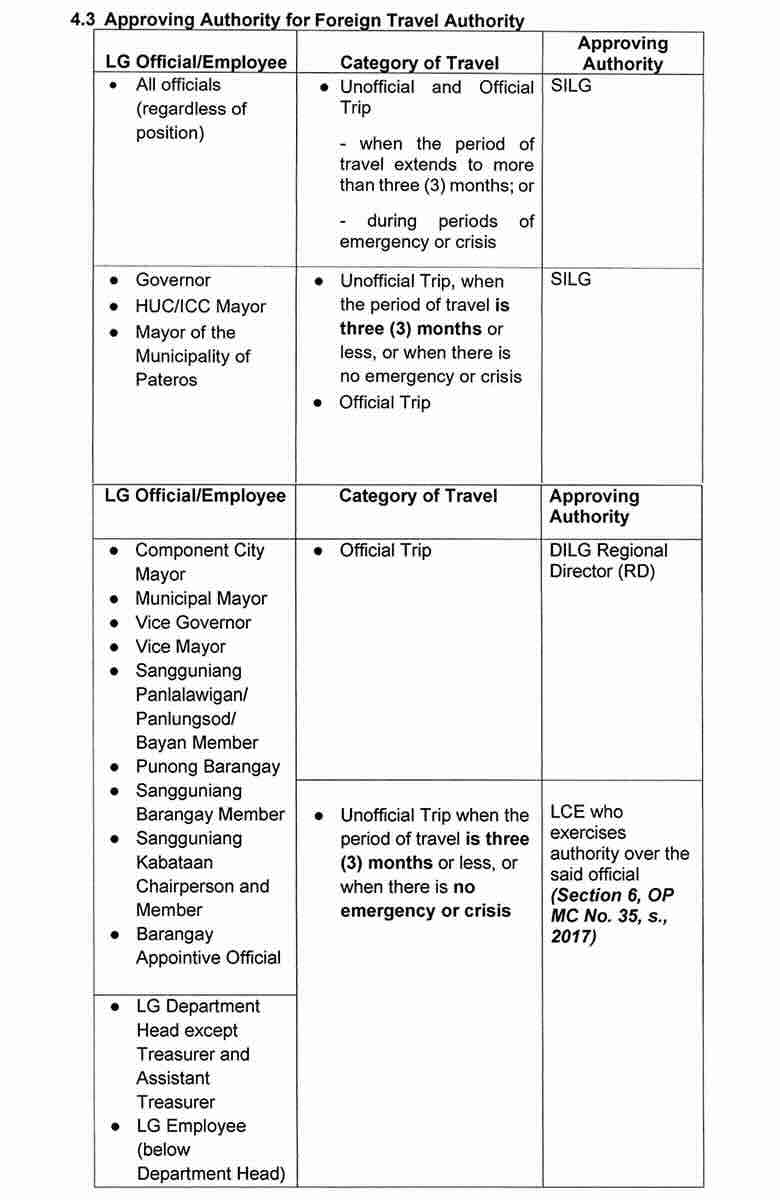
- If you are a government employee, you need to get a travel authority issued by the correct office.
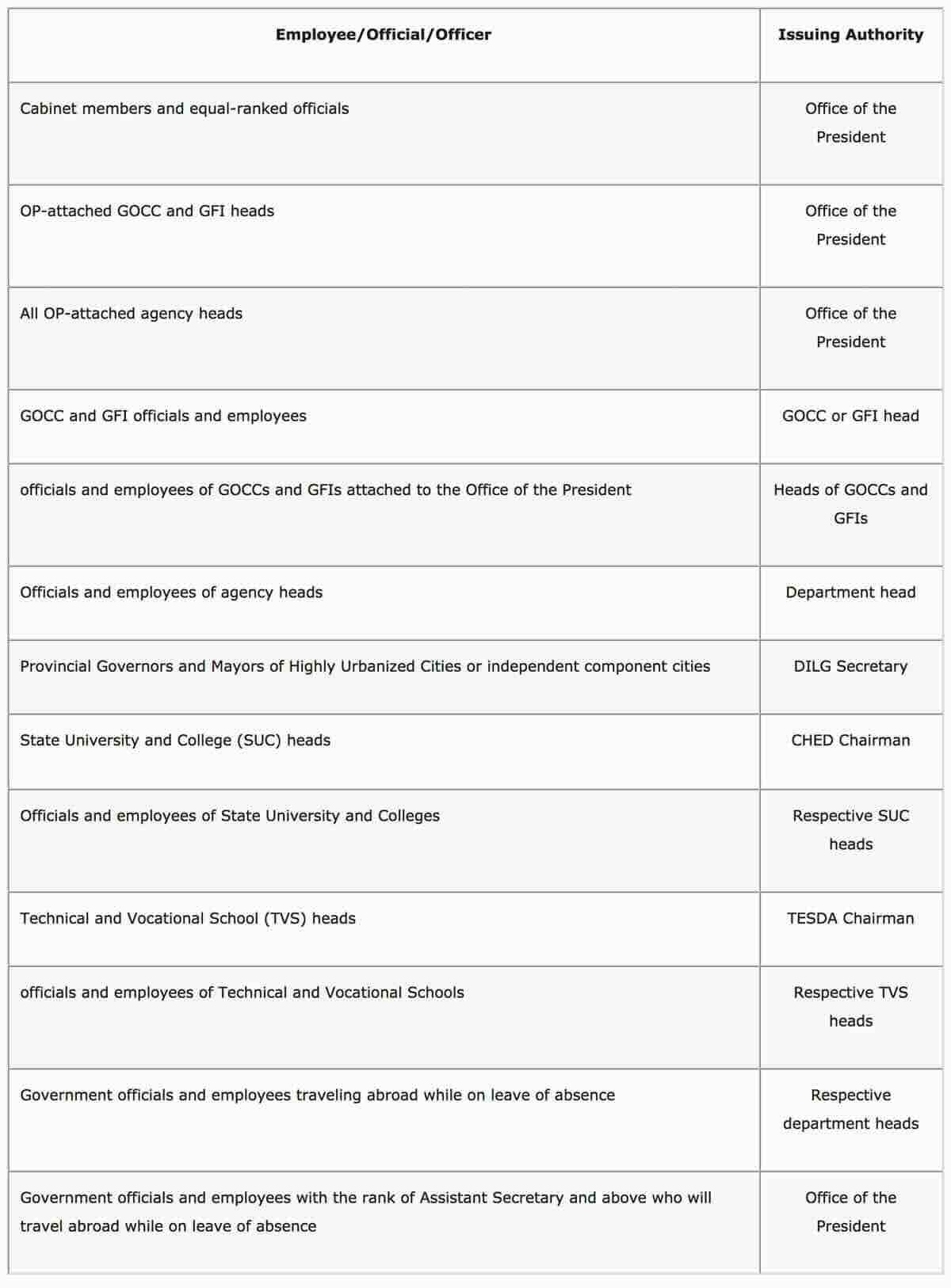

For local government employees, including barangay officials and SK members, these are the issuing or approving authorities. LCE means local chief executive.

For public school teachers, some are saying they need to present a travel authority signed by the Schools Division Superintendent (SDS). We are not very familiar with the process since we are not teachers.
There are also documents that may technically not be required, but the officer might ask for them if they have doubts. And these documents will prove that what you are saying is true and can convince the I.O. to believe you.
As our former Immigration Officer friend, Kevin, said in an interview on The Poor Traveler Podcast: The immigration process is document-based.
In the same way, if you said you are going to a concert and they ask for your concert ticket, you should present it. They will not just take your word for it.
If they ask about your job — where you work or what you do for a living, and you mentioned a company, be ready with company ID or Certificate of Employment. They may or may not check, but it is better to be prepared, just in case.
Many of us have that “baka lulusot” mentality because we heard that a friend or a vlogger did not get asked for certain documents. So, you assume you will not be asked, too. But what if you are asked?
Remember: the immigration officer does not know you. This is your first time meeting them. So they have nothing to hold on except the documents you show them when they ask for it, especially if you are a first-time traveler. They have no record about you. They are not sure if you will return. So always err on the side of caution and prepare all the possible documents you might be asked to present.
Red Flag #5: Cannot Prove Financial Capability
You cannot establish your financial capability to travel.
As what the Bureau of Immigration previously stated, tourists who are more likely to be questioned are:
- First-time tourists flying to a not-so-popular destination.
- Tourists with no steady source of income in the Philippines and no benefactors.
We already discussed the first point earlier (Red Flag #2). This time, let’s focus on the second item: Tourists with no steady source of income and no sponsor.
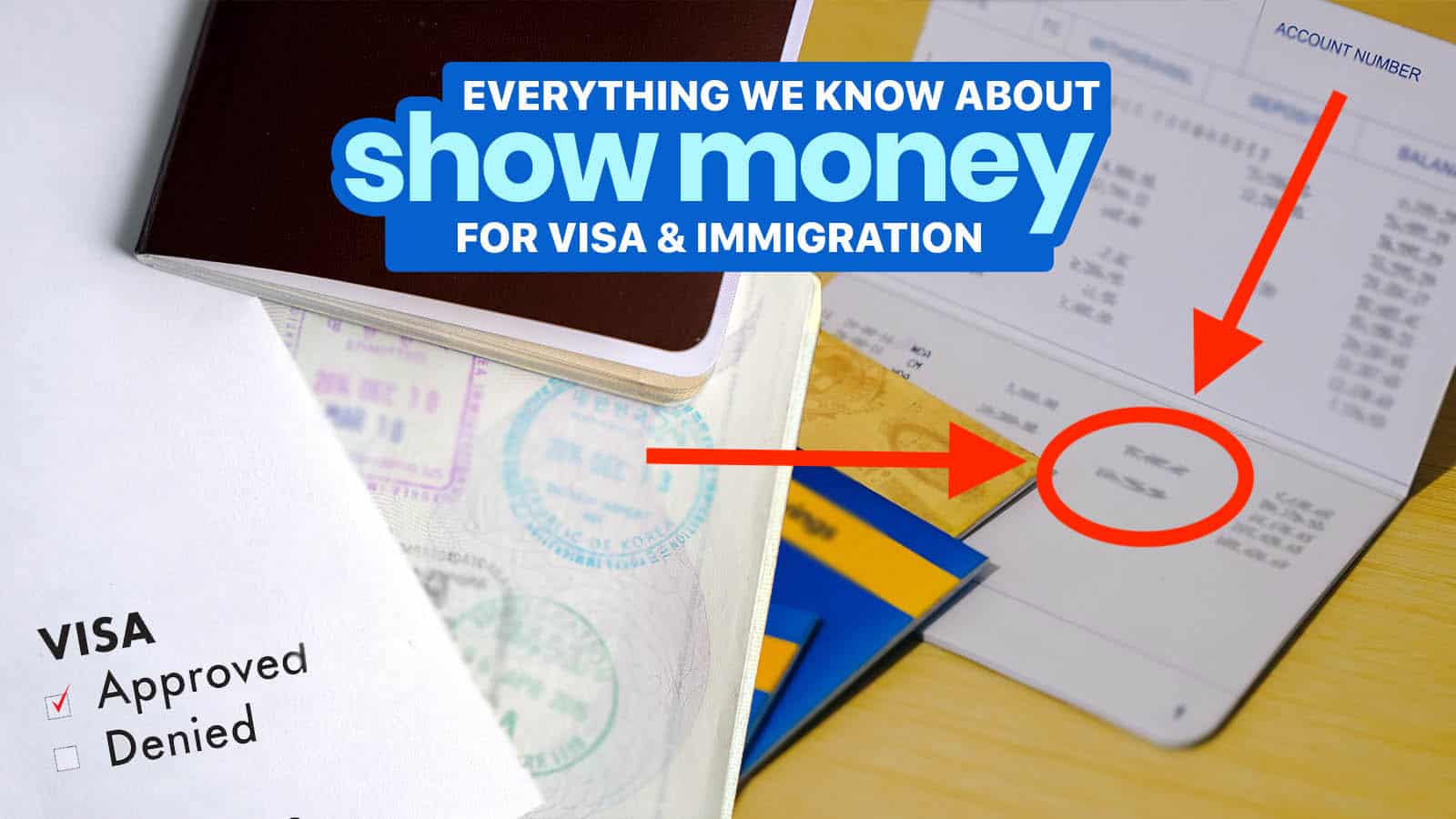
When immigration officers ask us about our job, where we work, and sometimes, even check our company ID or COE (Certificate of Employment), aside from determining if you can afford to travel, they are also assessing if you have a strong ties to the Philippines and a clear reason to return, and not become undocumented OFWs.
If you are unemployed or unable to clearly prove your source of income, expect to get asked more questions and a possibility to go through secondary inspection.
But let’s be clear. In a previous press release, the Bureau of Immigration emphasized this: Financial capability is NOT a requirement. However, “a person may only be asked to present further proof for his travel abroad if the person appears to have a reason different from what he has declared before an immigration official.”
But what can unemployed travelers do? Usually, immigration officers also ask for Affidavit of Support and Guarantee (AOSG).
But then again, just because you have an Affidavit of Support does not mean you are automatically cleared to leave the country. That’s where Reason #6 comes in.
Red Flag #6: Unable to Prove Relationship with Companion
You cannot prove your relationship with your companion or sponsor.
Many assume that having a sponsor or inviter abroad makes it easier for them to get a departure clearance from immigration officers. Unfortunately, it does not work that way. In some cases, I.O.s may even ask these types of travelers to present documents to prove their relationship with their sponsor or inviter.


The bureau is document-based. For example, if you say someone is your sister, you must provide a document proving that — like birth certificate.
Actually, we experienced this ourselves on one of our trips to Singapore. It was my aunt’s first international flight, and the I.O. was doubting that she and my mother were related because they got different last names and they had different facial features. Good thing we were prepared and brought supporting documents with us.
And another thing: even if you have Affidavit of Support, that is not an express pass. It does not automatically clear you. According to the Department of Foreign Affairs (DFA), “The Affidavit of Support and Guarantee is NOT a 100% GUARANTEE for you to be allowed exit from the country; it is only a SUPPORTING DOCUMENT that strengthens your CLAIM to LEGITIMATE TRAVEL.”
In the end, the immigration officer still has the final say on whether you have sufficiently established your purpose of travel.
Other details about the sponsor also matter, such as your relationship to them and whether they are Filipino or foreigner. Which brings us to Reason #7…
Red Flag #7: Traveling with a Non-Relative Sponsor
You are accompanied or sponsored by a non-relative foreigner and you do not have the capacity to travel.
According to the same memorandum and press release from Bureau of Immigration, included in the list of travelers who may be subject to secondary inspection are: “Travelers without financial capacity to travel escorted or accompanied by a foreigner who is not related.”
According to Kevin, this is one of the cases that the Bureau usually takes a closer look at and watch out for because of the high risk of human trafficking or illegal recruitment.
If you’re traveling for leisure or tourism and being sponsored by a foreigner who is not related to you — say, a boyfriend, girlfriend, or even just a friend — but the catch is, it is your first time to meet in person, you will most likely be offloaded.
It is really hard to prove the relationship if it is not on paper. Remember, immigration decisions largely rely on the documents presented. If you are married, you can show your marriage certificate. If you are related by blood, a birth certificate works. But if you are only dating, it is very tricky because there is no government document to formally prove the relationship.
Online communication, chats, or photos are easy to fake or manipulate digitally, so they are not considered strong evidence. So the tendency of immigration officer is to protect the Filipino traveler, especially if they also lack financial capacity to travel because they will be very vulnerable abroad.
Honestly, we constantly receive messages from people in this same situation asking for advice. But we find it hard to give guidance or advice because these cases are tricky and complicated.
Red Flag #8: Inconsistent or Unbelievable Answers
When facing an immigration officer and being asked questions, we must answer confidently, consistently, and truthfully.
And as we always say, the most important of the three is TRUTHFULLY. If you tell the truth, even if the officer fires multiple questions at you or twists them around, it is easier to remain confident and consistent.
It’s true that there are some travelers with honest intentions, that they really just want to tour, but they can still get offloaded. But lying or making up stories will make it exponentially worse. It is hard to keep track of lies, and I believe that immigration officers are trained to spot lies or inconsistencies.

Make sure you know all the details of your trip: where you are going, where you will stay, when you will return to the Philippines, and other relevant information. In our case, when we travel with family and have first-timers or inexperienced travelers, we usually hold a quick briefing at a café or restaurant at the airport just to make sure that we are on the same page and are familiar with the details of the trip. Because even among family or groups, people can still get offloaded.
We have witnessed it first hand. One one flight, a group was seated behind and beside us, and two of their companions were offloaded. We have also witnessed someone in a group being endorsed to secondary inspection while we were in the queue.
If an officer asks for a document, just show it. If they have question about it, answer truthfully. Getting too nervous can make things worse. Try to relax.
Red Flag #9: Previous Immigration Violations or Criminal Records
An immigration officer can stop you from flying if you are on a watch list or if you have outstanding legal or criminal case here in the Philippines.
And it is not just criminal record. If you have a history of overstaying abroad, expect to get a lot of questions. If you have done it before, you cannot fault them if they assume you could do it again.
According to a Rappler article based on a press release from Bureau of Immigration, passengers who are often subject to secondary inspection also include:
“Passengers who stayed abroad for more than one year during a previous departure from the country as a tourist/temporary visitor, intending to depart for the second and/or subsequent time.”
That is why it is also important to keep a clean travel record. If it is your first time and the officer asks when you are coming back, make sure you return on that date. Apparently, this is sometimes noted in the system, and they can see that you did return on the date you declared.
Red Flag #10: Previously Offloaded Without Compliance
Here’s a summary of what our friend Kevin said about this:
If you were previously offloaded and failed to comply with the required documents, trying to leave the country again from a different airport will not help. For example, one passenger was offloaded at Clark International Airport in the morning, then attempted to depart from NAIA later that evening without fixing the issue. Since her offloading record is already in the system, the passenger was offloaded again.


In short, make sure you comply with the requirements first before attempting to leave the country again.
Join The Poor Traveler Support Group
✅ If you have any questions or need travel tips, feel free to post them to the TPT Support Group. The members are very helpful. This Facebook support group has been around for a long time, and many members have found travel buddies through it. You can join too! Just visit The Poor Traveler Support Group. Note that this is different from The Poor Traveler Facebook page.

Protect your finances when traveling!
Getting a travel insurance is optional, but we highly recommend this, especially when traveling abroad. Travel can be unpredictable, and though we hope we’ll never use it, having it gives us peace of mind in case of unexpected delays, cancellations, or emergencies.
For international destinations, consider PGA Sompo’s TravelJOY Plus insurance. You can GET IT HERE. Don’t forget to use WORTHIT for a special affordable rate.


Updates Log
2026 2 14 – First uploaded
Edited by: Asta Alvarez
